BlkSabbath74
Leader of the Kurt Russell Mafia
- Messages
- 907
You’re Already Living in the Metaverse
Dave Chappelle is wrong. Twitter—and Instagram and Facebook and even this platform—are real life.
 bariweiss.substack.com
The term metaverse, like the term meritocracy, was coined in a scifi dystopia novel written as cautionary tale. Then techies took metaverse, and technocrats took meritocracy, and enthusiastically adopted what was meant to inspire horror.
Originally appearing by name in Neal Stephenson’s classic Snow Crash, the metaverse concept has been rehashed in other hits like Ready Player One or the film series The Matrix. In the Stephenson version, much as in Mark Zuckerberg’s uncanny Metaverse launch video, so-called “gargoyles” are otherwise normal humans who languish their entire lives inside a virtualized reality with headsets bolted to their faces.
If you’re wondering why someone like Zuckerberg with such immense resources (including an estate on paradisiacal Ku’uai) wants to blot out reality with a VR headset, then you need to understand the techie mindset. As more than one Valley character has un-ironically expressed to me in private: anything worth doing can be done better via screen.
Many Silicon Valley investment portfolios and lifestyles reflect that view. In-person dinners are still convened, but those IRL events are now a luxury add-on (and reflection of) digital life rather than vice versa. VCs invest vast sums in founders they’ve never physically met, and those startup founders hire people whose hands they’ve never shaken. The resulting companies have workforces who spend all day looking at each other via endless Zoom calls, but who never or rarely meet (I know, I’ve worked in them). The techies prefer intermediating reality and people via pixels and algorithms, and they’ve created the conditions such that the world meets them on their terms.
Not that we were very hard to convince.
Whether or not Zuckerberg’s Metaverse plan works out, the little ‘m’ metaverse is already here and we’re already living inside of it. It’s the elective, virtualized reality composed of Twitter, Instagram, and even the very Substack you’re reading right now. The tech “backlash” that the media has been trying to engineer (speaking of pleasant illusions) has never really happened, and you’d be hard-pressed to find signs of one in Facebook’s, or any other tech company’s, usage and revenue graphs.
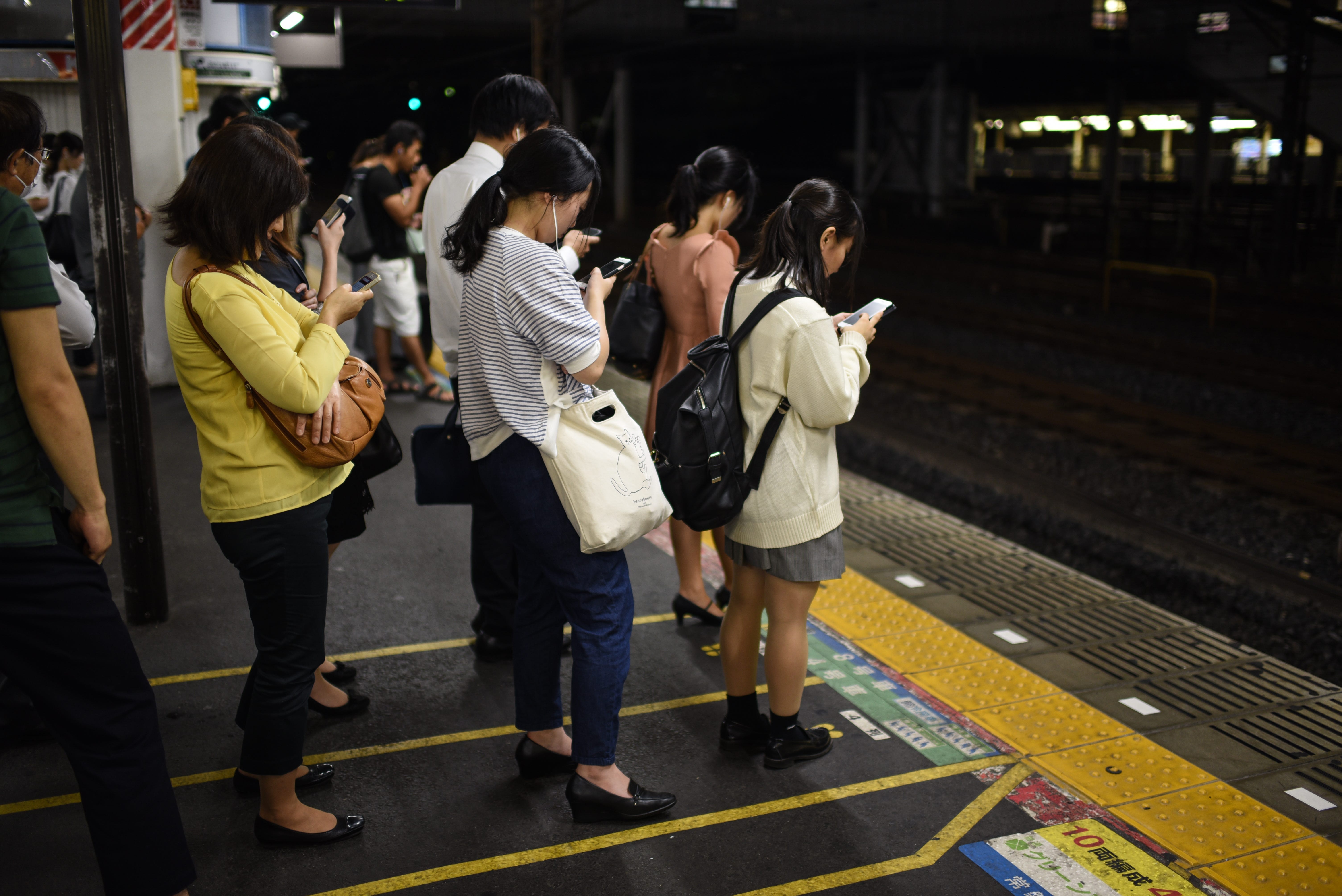 Waiting for the subway in Tokyo. (Nano Calvo/VW PICS/Universal Images Group via Getty Images)
More anecdotally, those who assert that “Twitter isn’t real life”, as Dave Chapelle did in his most recent and controversial Netflix special, are either delusional or disingenuous. Chapelle’s own brain has clearly been eaten by Twitter, as in the rest of his special he touched on every Twitter-mediated woke flashpoint of the past several months, and the blowback (and consequences) to his show were adjudicated on the very platform he claimed didn’t matter.
I used to think that online life constituted the shadows in Plato’s allegory of the cave, and those craning their necks into phones all day were the poor souls chained down and forced to watch the meaningless digital flickers of reality. After having to explain again and again to normies how some new real-world scandal, be it the fight over CRT, the latest Trumpian sound bite, or the lab-leak hypothesis, all had their origins among obscure corners and figures of the Internet, I now realize it’s the reverse: real life is increasingly a reflection of what happens online.
In our society of spectacle, the only hard, non-optional realities left are war, the markets, and elections. War has been outsourced and forgotten: consider how much longer the Chapelle discourse lasted than the debate about the Afghanistan debacle, the humiliating end to our nation’s longest conflict. Markets impact most people indirectly, but are still real enough to eventually cause a glitch in the matrix about inflation being under control (narrator’s voice: it’s not). Elections, however, are real enough to instantly slap us in the face and make entire fantastical worldviews crumble within a day.
Take the recent election results in Virginia, where Democrats have won every statewide election since 2009. In a state that Biden won by 10 points, Republicans swept. As with every surprise election result these days, this sparked a pageant of motivated reasoning and cognitive dissonance from a left-leaning mainstream media that tried to reconcile reality to their online-derived bubbles (rather than the reverse). In our increasingly Schrodinger-esque reality (he of the cat simultaneously alive and dead), the election was either not about CRT at all, or about CRT but only because nefarious forces had made it so.
Politics become strange when reality becomes optional.
Historically, the swirl of culture, media, and moral narratives that frame human life followed the contours of language, religion and tribe, which eventually coalesced into nation-states. That colored shape on the map, labeled ‘France’ or ‘Texas’ or whatever, defined your narrative world given the traffic in books and images still followed the paths of people and commerce. Only those living in the liminal intersection of two cultural worlds—say, someone like me raised in the Anglo/Latin entrepot of Miami—would be forced to constantly navigate entirely different worldviews.